
 By Robin Smith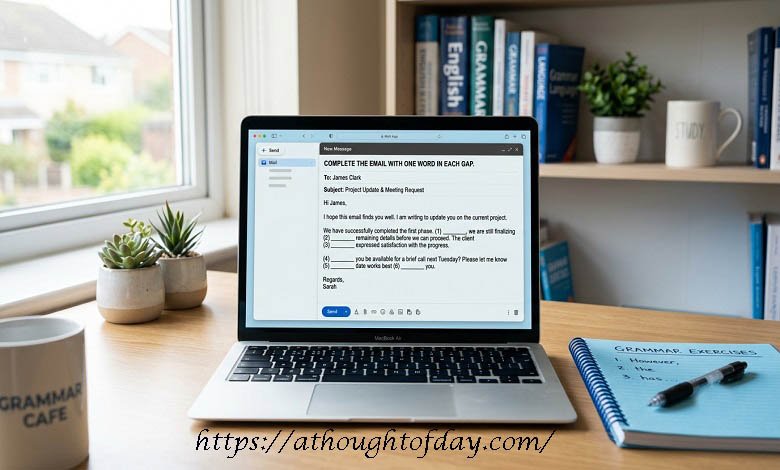
Complete the email with one word in each gap is a common type of English grammar and reading exercise. You are given an email with several missing words, and your task is to write one suitable word in each blank. The correct answer must fit the sentence grammatically and make sense in the overall context.
Although the exercise may look easy, it requires more than basic vocabulary. You need to understand sentence structure, common expressions, verb forms, prepositions and the relationship between ideas. With the right approach and regular practice, you can improve your accuracy and complete these exercises with greater confidence.
In this exercise, you read an email containing blanks where words have been removed. You must identify the missing word using the surrounding sentence and the meaning of the message.
For example:
I am writing _____ ask for information about your English course.
The correct answer is to because the phrase is writing to ask. Adding this word makes the sentence grammatically correct and preserves its meaning.
Unlike a multiple-choice exercise, you usually receive no list of possible answers. You must decide which word fits the gap yourself. The exact instructions can vary by textbook or examination, so always check whether contractions, alternative answers or other rules are permitted.
Completing an email with one word in each gap tests several connected English-language skills.
Grammar knowledge: You need to recognize the correct tense, articles, pronouns, auxiliary verbs and prepositions.
Vocabulary and collocations: Some words regularly appear together. For example, we say interested in, depend on and look forward to.
Reading comprehension: A word may depend on information in another part of the email, so understanding the whole message is important.
Context and meaning: You must choose a word that communicates the intended idea, whether the email is requesting information, explaining a problem or inviting someone to an event.
These skills are also useful when preparing for English proficiency examinations. Cambridge English exams, for example, include open-cloze tasks in which candidates supply missing words without multiple-choice options. However, the exact format and instructions can differ from an email-based exercise.
Understanding the most common word patterns can help you identify the correct answer more quickly.
Prepositions connect words and express relationships involving time, place, direction or purpose.
Examples include:
- Thank you _____ your message. (for)
- I am interested _____ joining the course. (in)
- We look forward _____ hearing from you. (to)
Learn common word combinations instead of memorizing prepositions in isolation. For example, look forward to is followed by a noun or an -ing verb.
Articles such as a, an and the often appear before nouns. Other determiners, including this, some and each, may also fit a gap.
Example:
I attended _____ interesting workshop yesterday.
Answer: an
The word an is correct because interesting begins with a vowel sound.
Pronouns replace nouns and help avoid repetition. Common examples include it, they, we, who and which.
Example:
My sister has joined a new school, and _____ is enjoying her classes.
Answer: she
The pronoun must agree with the person or thing being discussed.
Words such as is, have, do, will, can and would help form questions, tenses and polite requests.
Example:
_____ you please send me the application form?
Answer: Could
Modal verbs are particularly useful in formal emails because they help make requests polite.
Words such as and, but, because, although and if connect ideas and show how they relate to each other.
Example:
I could not attend the meeting _____ I was unwell.
Answer: because
The missing word introduces the reason for not attending.
A systematic approach is more reliable than guessing each answer individually.
Before filling in any blanks, read the email from beginning to end. Identify the sender’s purpose and the main message. Is the writer making a request, giving information, explaining a problem or arranging a meeting?
Understanding the context can reveal answers that are difficult to identify from a single sentence.
Read the complete sentence containing the blank. Pay attention to the word immediately before and after it.
For example:
She is good _____ solving difficult problems.
The phrase good at signals that the missing word is at.
Ask yourself what the sentence requires. Does it need a preposition, article, pronoun, auxiliary verb or linking word?
This narrows the possible answers and helps you avoid choosing a word that fits the general meaning but is grammatically incorrect.
Insert your proposed answer and read the sentence again. Check that the sentence sounds natural and that its meaning matches the rest of the email.
Some expressions require a particular word, while others depend on the relationship between two clauses. Grammar and context should work together.
Once you have completed all the gaps, read the entire email again. Check spelling, verb forms, subject-verb agreement and the one-word rule. If you are unsure about an answer, reconsider the surrounding words rather than choosing a complicated alternative without a grammatical reason.
Try the following exercise before checking the answers. Write exactly one word in each blank.
Dear Ms Brown,
I am writing (1) _____ enquire about your English course. I would like to know (2) _____ the next batch will begin and how much the course costs.
I am particularly interested (3) _____ improving my speaking skills because I need English for my studies. Could you please tell me (4) _____ the classes are held online or in person?
I would also like to know (5) _____ there is a certificate at the end of the course. Thank you (6) _____ your time and assistance.
I look forward (7) _____ hearing from you soon.
Kind regards,
Alex
- to — The expression writing to enquire explains the purpose of the email.
- when — The writer asks about the time the next batch will begin.
- in — The correct expression is interested in.
- whether — The sentence asks which of two possibilities applies: online or in person.
- whether — The writer asks whether a certificate is available.
- for — The standard expression is ” thank you for your time.
- to — The fixed expression is look forward to hearing from you.
The important lesson is that each answer comes from a grammatical pattern or the meaning of the sentence. Memorizing these patterns and learning to recognize them in context can make future exercises easier.
Even learners with a good vocabulary can lose marks by overlooking small grammatical details.
- Reading only the sentence fragment: Some answers depend on the wider context of the email.
- Ignoring fixed expressions: Phrases such as interested in and look forward to have established grammatical patterns.
- Choosing a word based only on meaning: A word may seem logical but still be grammatically incorrect.
- Writing more than one word: If the instruction requires one word per gap, do not enter a phrase.
- Forgetting spelling and grammar: A suitable word can still be marked incorrect if it is misspelled or used in the wrong form.
A useful habit is to explain why each answer is correct. This develops a deeper understanding of English grammar than simply checking an answer key.
Regular, focused practice is more effective than completing many exercises without reviewing your mistakes.
Read short emails, letters and other English passages, paying attention to prepositions, pronouns and linking words. Keep a notebook of useful expressions, such as apply for, apologise for, responsible for and look forward to. Write your own example sentences to understand how each expression works.
You should also practise under timed conditions once you understand the basic rules. After each exercise, review every incorrect answer and identify the reason for the mistake. Over time, this approach can improve grammatical accuracy, reading comprehension and confidence in written English.
Also Read: Understanding the Circular Flow Diagram: A Complete Guide to Economic Interactions
Learning to complete the email with one word in each gap becomes easier when you focus on grammar, context and common English expressions. Read the full message before answering, use the surrounding words as clues and check every response carefully. With consistent practice and a clear understanding of your mistakes, you can develop stronger English skills and approach gap-fill exercises with greater confidence.
A. Read the entire email first, examine the words around each blank, identify the required grammatical pattern and check that your answer fits the context. Review all answers before finishing.
A. Common answers include prepositions, articles, pronouns, auxiliary verbs, modal verbs and conjunctions. Fixed expressions and common collocations are also important.
A. Sometimes, depending on the sentence and the exercise’s marking rules. If multiple answers are accepted, follow the instructions provided by your teacher or examination board and write only the permitted number of words.
A. Yes. It develops grammar awareness, reading comprehension and contextual understanding. Similar open-cloze exercises appear in some English proficiency exams, although the format and scoring rules vary.
A. Start with short emails and basic grammar patterns. Practise prepositions, articles, pronouns and linking words before moving on to more complex sentences. Review mistakes regularly to understand why each answer works.
 Mustafizur