
 By Mustafizur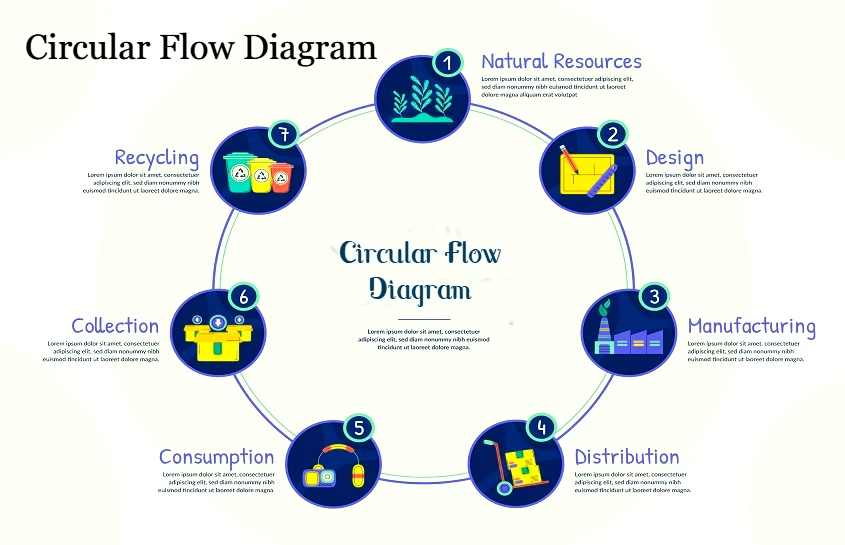
The circular flow diagram is one of the earliest models students encounter when studying economics, yet it remains one of the most powerful. At first glance, it may seem simple—almost too simple—but behind its clean structure lies a detailed explanation of how real economies function daily.
Every wage earned, every product sold, and every service consumed is part of a continuous movement of money and resources. The circular flow diagram captures this movement. It does not focus on individual transactions in isolation, but instead shows how households, firms, and other sectors depend on one another to keep economic activity alive.
In this article, we take a deep, practical look at the circular flow diagram economics framework. We will explain the diagram of circular flow of income, explore real-world circular flow diagram practice, and examine how the circular flow diagram of economy helps economists understand growth, stability, and change.
In economics, the circular flow diagram is a visual model that explains how income, resources, goods, and services move continuously between different participants in an economy. Rather than viewing the economy as a collection of separate actors, this model shows how each group is connected.
At its most basic level, the diagram shows two main groups:
- Households, who provide labor and other resources
- Firms, who produce goods and services
Money flows in one direction, while goods and services flow in the opposite direction. This two-way movement illustrates a fundamental idea in economics: production and consumption are interdependent. One cannot exist without the other.
Although the diagram is simplified, it reflects a real economic truth—income is generated through production, and production is sustained through spending.
To fully understand any diagram of circular flow of income, it helps to break the model into its main components. Each plays a specific role in maintaining economic balance.
Households include individuals and families. Their primary economic role is to supply factors of production such as labor, land, capital, and entrepreneurial ability. In return, households receive income.
This income is not just wages. It may also include rent, interest, and profit distributions. Once households receive income, they decide how much to spend and how much to save. This decision has a direct impact on the rest of the economy.
Firms organize production. They combine labor, capital, and other inputs to produce goods and services. Firms pay households for resources and sell finished products in the product market.
Without household spending, firms cannot earn revenue. Without firms, households would have no source of income. The circular flow diagram emphasizes this mutual dependence.
The product market is where goods and services are exchanged. When households buy food, clothing, transport, or digital services, money flows from households to firms. These payments form the revenue that allows businesses to operate.
The factor market is where firms purchase inputs. Wages, salaries, rent, and interest payments flow from firms to households here. This is how income enters the household sector.
The simplest circular flow diagram economics model includes only households and firms. Despite its simplicity, this version captures the core logic of an economy.
- Households provide labor to firms
- Firms pay wages and salaries
- Households use income to buy goods and services
- Firms receive revenue and continue production
This loop repeats continuously. If any part of the cycle weakens—such as a drop in consumer spending—the effects spread throughout the system. Production slows, incomes fall, and further spending declines.
This is why economists use the circular flow diagram to explain recessions, recoveries, and economic stability.
Real economies are more complex than the two-sector model. To reflect reality more accurately, economists expand the circular flow diagram of economy by adding other sectors.
The Government Sector
Governments collect taxes from households and firms. These taxes reduce disposable income but allow governments to provide public goods and services.
Government spending flows back into the economy through:
- Infrastructure projects
- Public sector wages
- Social programs
- Public services
This spending supports demand and can stabilize economic activity during downturns.
Not all household income is spent. Some is saved. These savings enter the financial system, where they are made available for investment.
Firms borrow funds to:
- Expand production
- Purchase machinery
- Invest in research
- Hire more workers
This process connects saving and investment, ensuring that unused income still supports economic growth.
Read More: How Gomyfinance.com Saving Money Guides Can Improve Your Finances
Theory becomes meaningful when it explains real behavior. Circular flow diagram practice involves applying the model to everyday situations.
A Small Business Example
Consider a local bakery:
- Residents work at the bakery and earn wages
- The bakery sells bread and pastries to households
- Households spend income at the bakery
- The bakery uses revenue to pay wages and buy supplies
This simple interaction mirrors the circular flow diagram perfectly.
A National Economy Example
At a national level:
- Workers earn income from businesses
- Businesses invest in new technologies
- Governments tax income and spend on infrastructure
- Households buy both domestic and imported goods
Each transaction fits somewhere within the circular flow of income.
The circular flow diagram economics model matters because it provides clarity. It explains how individual decisions combine to create large-scale economic outcomes.
Economists use it to:
- Understand how income is generated
- Analyze changes in spending patterns
- Study the effects of taxation and government spending
- Explain economic growth and contraction
Without this model, it would be difficult to see how separate markets are linked into a single economic system.
In expanded models, economists identify leakages and injections.
Leakages
Leakages are withdrawals from the flow of income:
- Savings
- Taxes
- Imports
These reduce the immediate level of spending in the economy.
Injections
Injections add spending:
- Investment
- Government expenditure
- Exports
Economic stability depends on the balance between leakages and injections. When injections exceed leakages, income rises. When leakages exceed injections, economic activity slows.
The circular flow diagram of economy helps explain how GDP is calculated. Every unit of output produced generates income, and every unit of income supports spending.
GDP measures the total value of:
- Consumption
- Investment
- Government spending
- Net exports
These components correspond directly to flows shown in the circular flow diagram, making it a foundational tool in macroeconomic analysis.
Read More: NVDA Max Pain: What Traders Need to Know
Different versions of the diagram are used depending on the purpose:
- Two-sector models for basic understanding
- Three-sector models including government
- Four-sector models including finance
- Five-sector models including international trade
Each variation adds realism while preserving the core logic.
A common misunderstanding is that the diagram represents a perfectly balanced system. In reality, economies experience shocks, inequality, and structural change.
The circular flow diagram does not show:
- Income distribution
- Market power differences
- Environmental costs
It is a framework, not a complete map of economic reality.
To deepen understanding:
- Analyze how a tax increase affects spending
- Examine the impact of rising exports
- Consider what happens when households increase savings
These exercises strengthen intuition and analytical skills.
The circular flow diagram remains one of the most effective tools for understanding how economies function. It shows that income, production, and spending are not isolated events but parts of a continuous process.
By mastering the diagram of circular flow of income, students and readers gain insight into how decisions ripple through the economy. From small businesses to national policy, the circular flow diagram provides a clear and lasting framework for economic thinking.
It reminds us that economies move not in straight lines, but in cycles—driven by people, choices, and constant interaction.